專題著作・第 14 篇
從聞法到發心
認識《大日經》14 Understanding the Mahāvairocana Sūtra – Part 14 不空師父/文 Written by Master BuKong
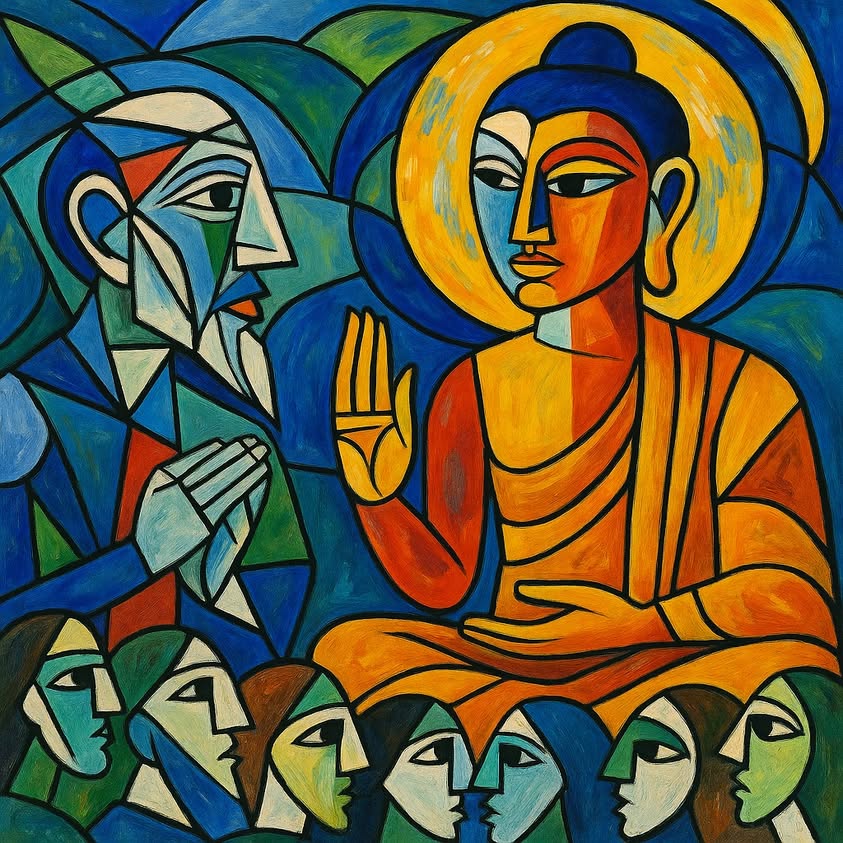
這時執金剛祕密主在大眾中,向大日如來種種請法: At that time, Vajra-Holding Secret Lord stood among the assembly and made various Dharma inquiries to Mahāvairocana Tathāgata:
「世尊!如來作為應供者,是成就正等正覺的大覺者,如來是如何證得這遍滿無盡的『一切智智』呢?」 "World-Honored One! As the Worthy Recipient of Offerings, the Tathāgata has attained supreme and perfect enlightenment. How did the Tathāgata realize this all-pervading and boundless 'Wisdom of All-Knowledge' (sarvajñajñā)?"
「世尊!如來如何做到,能依眾生不同的意趣、性格和欲求,而給予方便之道,來宣說這遍滿無盡的『一切智智』呢?」 "World-Honored One! How is it that the Tathāgata, in accordance with the varying dispositions, temperaments, and desires of sentient beings, is able to provide skillful means and proclaim this boundless 'Wisdom of All-Knowledge'?"
據《大智度論》說:「所謂『薩婆若』,就是『一切智』…總攝一切法…,包含了共通特相或差別特相,包含了有漏、無漏、有為、無為,包含種種法的特徵、功能、因緣、果報、本性、成壞,遍知世間與出世間的究竟智慧,因此稱為『薩婆若』。」 According to the Mahāprajñāpāramitā Śāstra, "'Sarvajña' refers to 'All-Knowing Wisdom'… it encompasses all dharmas… including universal characteristics and distinguishing marks; includes defiled and undefiled, conditioned and unconditioned phenomena; embraces various features, functions, causes and conditions, karmic results, essential nature, arising and cessation—thus thoroughly knowing the ultimate wisdom of both the mundane and supramundane realms. Hence it is called 'sarvajña'."
而《大日經》中此處所說的「一切智智」,是在一切智之上的最上智慧。 But in this part of the Mahāvairocana Sūtra, the 'Wisdom of All-Knowledge' (sarvajñajñā) refers to the supreme wisdom that surpasses ordinary omniscience.
「一切智智」不僅通曉一切法的總體與細節,更深刻了知這些法的最終實相,猶如金剛,不增不減,不變不壞。 This 'Wisdom of All-Knowledge' not only understands the totality and the details of all dharmas, but profoundly realizes their ultimate nature—like the vajra: unarising, unceasing, unchanging, and indestructible.
這種「一切智智」的自證境界,無法用語言來表達,也無法用眼睛觀察,更不像手中握有菴摩勒果(印度的餘甘子),能傳遞此果給他人。 This self-realized state of the 'Wisdom of All-Knowledge' cannot be expressed in words, nor perceived with the eyes. It is not like holding an āmalaka fruit (Indian gooseberry) in one’s hand, which can be physically passed to another.
如果「一切智智」能用言語傳授給他人,那麼釋迦牟尼佛在過去行菩薩道時,在接受燃燈佛授記時,便就應該立刻成佛了。為什麼還要經過累生累劫的修行、具足種種方便善巧,才能最終覺悟而成佛呢? If this 'Wisdom of All-Knowledge' could be transmitted through words, then when Śākyamuni Buddha received the prophecy from Dīpaṃkara Buddha during his Bodhisattva path, he should have attained Buddhahood immediately. Why then did he need to undergo countless lifetimes of cultivation, perfecting various skillful means, to finally realize Buddhahood?
正因為「一切智智」無法由他人傳遞,只能靠自我證得,所以這樣的覺悟才稱為「佛」。 It is precisely because this 'Wisdom of All-Knowledge' cannot be handed down by others and must be realized through one’s own direct experience that such awakening is called 'Buddhahood'.
執金剛祕密主繼續說: The Vajra-Holding Secret Lord continued:
「如來對某些眾生說聲聞乘、緣覺乘乃至大乘,或對某些眾生說五種神通或滿足他們想生到天界、人間,乃至護法龍天等願望而說法。」 "The Tathāgata teaches certain beings the Śrāvaka Vehicle, the Pratyekabuddha Vehicle, or even the Mahāyāna. For others, he expounds on the five types of supernormal powers, or fulfills their wishes to be reborn in the heavens, human world, or among the Dharma-protecting nāgas and devas."
「若有眾生與佛有緣,應當得度,如來就會示現與他們相應的形象,如佛身、聲聞、緣覺、菩薩身、梵天、那羅延、毘沙門身,甚至護法龍天、人或非人等的形象,與其語言相同、行儀相近來接引他們。」 "If sentient beings have a karmic connection with the Buddha and are ready to be liberated, the Tathāgata manifests in forms corresponding to them—such as the Buddha’s form, or as a śrāvaka, pratyekabuddha, bodhisattva, Brahmā, Nārāyaṇa, Vaiśravaṇa, or even protectors like nāgas, devas, humans, or non-humans—adopting their language and comportment to guide them."
「但無論佛以何身說法,所傳達的法義只有一味,即『如來的解脫味』」。 "Yet regardless of the form the Buddha takes to teach, the essence of the Dharma remains one taste—'the Tathāgata’s flavor of liberation'."
由上看來,諸佛安立無量的方便法門,示現無量的身形,與各類眾生使用相同的語言音聲,採取與他們相應的威儀姿態。 From the above, it can be seen that the Buddhas establish innumerable skillful means, manifest in countless forms, speak in the same languages and sounds as various beings, and adopt comportments that match theirs.
那麼,這種不可思議的方便究竟是怎麼來的呢? Then, how does such inconceivable skillful means arise?
龍樹菩薩說:「般若與方便在本體上是一樣的,只是在運用上有所不同。就像金匠用靈巧的方法,把金子製作成各種不同的器物,雖然形狀各異,但本質都是金。」 Nāgārjuna Bodhisattva said: “Prajñā (wisdom) and upāya (skillful means) are the same in essence, differing only in their application. It is like a goldsmith skillfully crafting gold into various objects—though the forms vary, their substance is the same: gold.”
如來雖用種種方便教化眾生,但其根本智慧皆不離一味——如來的解脫味。 Although the Tathāgata uses various skillful means to teach sentient beings, the root wisdom behind them all remains of one flavor—the Tathāgata’s flavor of liberation.
「大日如來」以遍一切處的「真金智體」(即圓滿清淨無礙的佛智)作為材料,建立出種種法乘來度眾,其實這就是「大悲胎藏界曼荼羅」的建立。 Mahāvairocana Tathāgata, using the “True Golden Wisdom Body” (that is, the perfect, pure, unobstructed wisdom of the Buddha) as the universal material, established various Dharma vehicles to liberate beings—this, in fact, constitutes the creation of the “Great Compassion Womb Realm Maṇḍala” (Mahākaruṇā Garbhadhātu Maṇḍala).
在一切智智的平等心地中,化現種種佛、菩薩、聲聞、緣覺、天龍八部等四種法界的圓滿壇城,並且每一位本尊的身(手印)、語、意都是依據不同的「乘」所展現的差別方便。 From the equal mind-ground of the Wisdom of All-Knowledge arise manifestations of various Buddhas, Bodhisattvas, Śrāvakas, Pratyekabuddhas, and the Eight Classes of Devas and Nāgas, forming a complete maṇḍala of the four Dharma realms. Each deity’s body (mudrā), speech (mantra), and mind (concentration) manifest distinct skillful means according to different vehicles (yānas).
比如有人發心想修「五種神通」(神足、天眼、天耳、他心、宿命),那大悲胎藏界曼荼羅中就會感應顯化出一位本尊,教導行者修持真言行法。若行者能精進不懈,不久之後便能成「五通仙人身」,再從此仙人身經由方便引導,最終相應為大日如來之身。 For instance, if someone aspires to cultivate the five supernormal powers (spiritual foot, divine eye, divine ear, telepathy, and past-life recall), then within the Great Compassion Womb Realm Maṇḍala, a corresponding deity will manifest in response, guiding the practitioner in mantra and tantric practice. If the practitioner persists with diligence, they will soon attain the “body of the sage with five powers,” and from that state, through further skillful guidance, ultimately attain the body of Mahāvairocana Tathāgata.
如來宣說各種法乘,皆是為令眾生覺悟而設,所以經中才說:「皆同一味,所謂如來解脫味。」 The Tathāgata teaches the various Dharma vehicles all for the sake of awakening sentient beings. Thus, the scripture declares: “All are of one taste—what is called the Tathāgata’s flavor of liberation.”
一切眾生的色身與心性,從無始以來的真實本質,就是大日如來的平等智身,不是等到成佛後才「強行空掉」眾生法而成就平等智身。 The physical bodies and mental natures of all sentient beings, from beginningless time, inherently share the same essential nature—the Equal Wisdom Body of Mahāvairocana. It is not the case that their qualities must be forcibly “emptied” only after attaining Buddhahood in order to become this Equal Wisdom Body.
因此,如來從自身平等心地中,開展無盡的莊嚴法藏與大悲胎藏曼荼羅壇城,以此啟發眾生自身的平等心地與無盡莊嚴。 Thus, from the Tathāgata’s own equal mind-ground arise the boundless treasury of adorned Dharma teachings and the Great Compassion Womb Realm Maṇḍala altar. Through this, he inspires sentient beings to awaken their own equal mind-ground and inexhaustible adornments.
若以真言的角度而言,如同一切語言都發生於「阿字門」(阿字有本不生的意思),因此修真言行的行者應當了解,一切感應與方便的生起,無一不是從「阿字門」中產生。如同大海中的波浪,看似彼此激盪、互為因緣,但實際上都同具一種味道——也就是「鹹味」。 From the perspective of mantra practice, all sounds and languages arise from the “gate of the syllable A” (the 'A' symbolizing the unborn nature). Thus, practitioners of mantra should understand that all responses and skillful means arise from this very gate of 'A'. Just like the waves of the ocean—though they appear to clash and interact with one another as causes and conditions, they all share the same single flavor: the salty taste.
Translated into English by ChatGPT.