專題著作・第 11 篇
越三時與三密法門
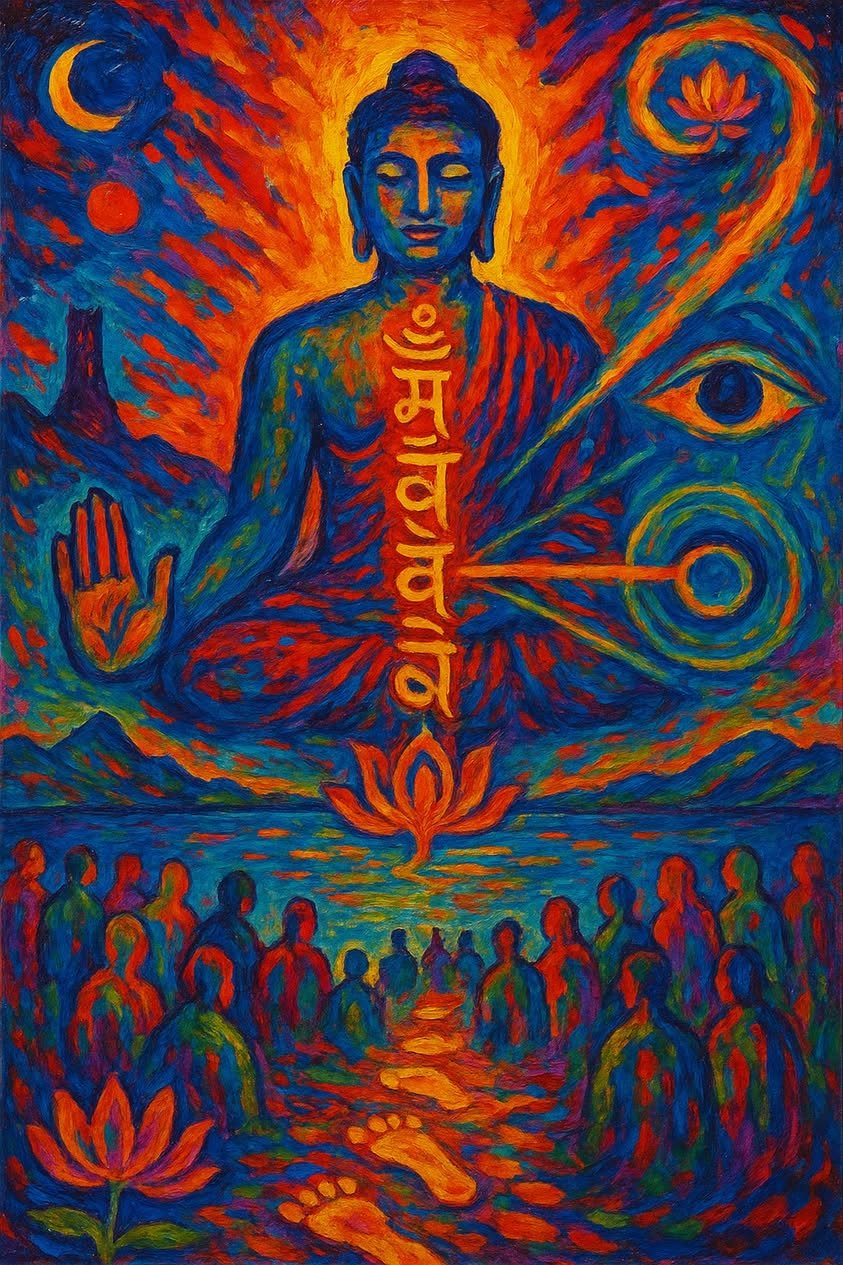
認識《大日經》11 Understanding the Mahāvairocana Sūtra – Part 11 不空師父/文 Written by Master BuKong
與會大眾欲共同聽聞,大日如來所說法教,那麼,這究竟會是什麼殊勝的法義呢? The assembly wishes to collectively listen to the Dharma teachings spoken by Mahāvairocana Tathāgata. Then, what kind of supreme Dharma principle could this possibly be?
《大日經》記載:「所謂。越三時。如來之日加持故。身語意平等句法門。」 The Mahāvairocana Sūtra records: “Transcending the three times. Due to the empowerment of the Tathāgata’s Day. The Dharma gate of the equality of body, speech, and mind in phrases.”
前面提到諸執金剛與諸菩薩們,分別對應的無量眷屬與無量法門,若需要一一講述,依如來加持力所證得的身、語、意差別法門功德,那麼所需要的時間,該如何想像? As previously mentioned, the various Vajra Holders and Bodhisattvas correspond to countless retinues and countless Dharma gates. If one were to expound each individually—based on the powers attained through the Tathāgata’s empowerment in body, speech, and mind—how much time would that require? It is beyond imagination.
世間對時間的觀念,區分過去、現在、未來,以及長短不同的時間量度、尺度。 The worldly understanding of time distinguishes between past, present, and future, and measures time in varying lengths and scales.
又從地球的角度,看太陽東昇西落在天上運行,而晝夜轉換亦有初、中、後等三個分段,因為一切世間的運作,沒有剎那的停止,都正在不停地流轉,因此時間的度量分割也因應而生。 From the perspective of Earth, we see the sun rise in the east and set in the west as it moves across the sky. Day and night are divided into early, middle, and late phases. Since all worldly phenomena are in constant motion without a single moment’s pause, the measurement and division of time arise accordingly.
但從清淨的慧眼觀察緣起,所謂時間的過去、現在、未來相狀,是無法真實把捉的,沒有起點、終點,空間的去與來,亦是在相對的度量中比較,此即所謂「越三時」。而慧眼所見的實相,好比不滅光明、清淨虛空,超越時空的限制。 However, when observed through the pure wisdom eye and the lens of dependent origination, the distinctions of past, present, and future cannot truly be grasped. There is no real beginning or end; even the movement of space—from here to there—is only relative measurement. This is what is meant by “transcending the three times.” The reality seen by the wisdom eye is like undying light and pure, empty space—beyond the limitations of time and space.
而大日如來的神通力,使修行者能歷經無量劫中猶如短暫一頓飯的時間,反之,亦能使人經歷一頓飯的時間中,猶如經歷無量劫。 By the divine power of Mahāvairocana Tathāgata, a practitioner can experience the span of countless kalpas as if it were but the time of a single meal. Conversely, one can also experience the time of a single meal as if it were countless kalpas.
這種延展、壓縮時間長短的神通自在之力,如來隨不同根器的與會者而適應調整,並無固定的相狀能形容與定義,此即「如來之日加持故」。 This miraculous ability to extend or compress time at will is adjusted by the Tathāgata in accordance with the capacities of different beings in the assembly. It has no fixed form that can be described or defined. This is what is meant by “due to the empowerment of the Tathāgata’s Day.”
那麼,在如來神通所現的「如來之日」時空中,大眾所聽聞的是什麼法呢? Then, within the time-space manifested by the Tathāgata’s divine power—known as the “Tathāgata’s Day”—what Dharma do the assembly hear?
即是「身語意三平等句法門」。 It is the “Dharma gate of the equality of body, speech, and mind in phrases.”
首先,必須明瞭如來的身語意三業,皆是究竟第一,真實圓滿的極妙境界,身等於語、語等於意(心),猶如大海,無論何處皆為同一鹹味,所以稱為「身語意三平等」。 First, we must understand that the Tathāgata’s three karmas of body, speech, and mind are supreme, ultimately real, and perfectly complete. The body is equivalent to speech; speech is equivalent to mind—just like the ocean, whose water tastes equally salty no matter where you draw it from. Thus, it is called “the equality of body, speech, and mind.”
「句」這個字,梵語「鉢曇」,原意是「腳步」。梵語的聲論學中有「前進」或「落腳處」的意思。 The word “phrase” (句, gou) comes from the Sanskrit “pada,” which originally means “footstep.” In Sanskrit phonetics, it can also mean “progress” or “place of stepping.”
就像人行走時,腳步曾一一停留的足跡,就稱為「句」。如同文章中的詞語段落,也有句逗,用來表示語意的停留與發展。 Just as a person’s footsteps leave marks where they have momentarily paused, each is called a “phrase.” Likewise, in writing, sentences and clauses serve to indicate pauses and the unfolding of meaning.
在真言宗的修行中,這個「句」指依照修道的足跡、軌跡前進,次第前進,方能安住於如來的「身語意三平等」境界中。 In the esoteric practices of the Mantrayāna tradition, “phrase” refers to following the footsteps and tracks of the path of cultivation. Only by proceeding step by step can one abide in the Tathāgata’s state of “equality of body, speech, and mind.”
如以身的密印、語(口)的真言、意(心)的妙觀作為方便,進入三平等的密法門,進而證得如來的加持受用身,即是遍一切處的毘盧遮那佛法身,在行者自身而言又稱「平等智身」。 By skillfully applying the mudrā of the body, the mantra of speech, and the subtle contemplation of the mind, one enters the esoteric Dharma gate of the threefold equality. Through this, one attains the Tathāgata’s empowered body of enjoyment—namely, the Dharma body of Vairocana that pervades all places. For the practitioner, this is also called the “body of equal wisdom.”
因此住於「身語意三平等」法門的行者,便入於不行而行、不到而到的「平等句法門」。 Thus, a practitioner abiding in the Dharma gate of the equality of body, speech, and mind enters the “Dharma gate of equal phrases”—wherein one walks without walking, and arrives without going.
進而體證一切眾生,入此法門中,而無實在不變的眾生能入,亦無實在能入的入處,這就是真正的「平等」。 They then realize that all sentient beings can enter this Dharma gate, yet there is no truly fixed “being” who enters, nor is there any concrete “place” into which they enter. This is the true meaning of “equality.”
由此看來,「身語意平等句法門」,正是《大日經》的核心大意。 From this perspective, the “Dharma gate of the equality of body, speech, and mind in phrases” is truly the central essence of the Mahāvairocana Sūtra.
Translated into English by ChatGPT.