專題著作・第 18 篇
本具菩提仍須修行
認識《大日經》18 Understanding the Mahāvairocana Sūtra – Part 18 不空師父/文 Written by Master BuKong
大日如來開示了「菩提心為因,大悲為根本,方便為究竟」,揭示了「菩提」即是「如實知自心」的深刻意涵,但又說「菩提如虛空無相」,這樣的法義引發兩種疑問: Mahāvairocana Tathāgata proclaimed: “Bodhicitta is the cause, great compassion is the root, and skillful means are the ultimate.” He revealed the profound meaning that bodhi (awakening) is none other than “truly knowing one’s own mind.” However, he also stated that “bodhi is like space—formless.” This profound teaching gives rise to two questions:
一、如果「菩提」即是「如實知自心」,那麼眾生是否不需修行,就能證悟成佛?因為一切功德都在心中具足了,不是嗎? 1. If bodhi is simply “truly knowing one’s own mind,” does that mean sentient beings do not need to practice in order to attain enlightenment and Buddhahood? After all, all merits and virtues are inherently complete within the mind—are they not?
二、若「菩提如虛空無相」,那麼往內觀照這個「自心」或成就「一切智智」的主體是誰?或是什麼? 2. If bodhi is like empty space and without form, then who is it that turns inward to contemplate the “mind itself”? Or, who or what is the subject that realizes “the wisdom of omniscience”?
為斷除未來眾生的疑惑,祕密主向如來請問:「世尊!是誰在尋求一切智?是誰證得菩提、成就佛果?又是誰能發起『一切智智』的智慧呢?」 To dispel the doubts of future beings, the Lord of Secrets (Guhyakādhipati) asked the Tathāgata: “World-Honored One, who is it that seeks omniscient wisdom? Who realizes bodhi and attains Buddhahood? And who is it that can give rise to the wisdom of omniscience (sarvajñājñā)?”
大日如來說:「祕密主!是『自心』在尋求『菩提』及『一切智智』。為什麼呢?因為『自心』的本性是『清淨』的。我所指的自心不在身內、不在身外,也不在內外中間,若想找到一個實在可得的『自心』,是找不到的!」 Mahāvairocana replied: “Lord of Secrets, it is the ‘mind itself’ that seeks bodhi and omniscient wisdom. Why? Because the nature of this mind is pure. The ‘mind’ I speak of is neither within the body, nor outside it, nor in between. If one tries to locate a truly graspable ‘mind,’ it cannot be found.”
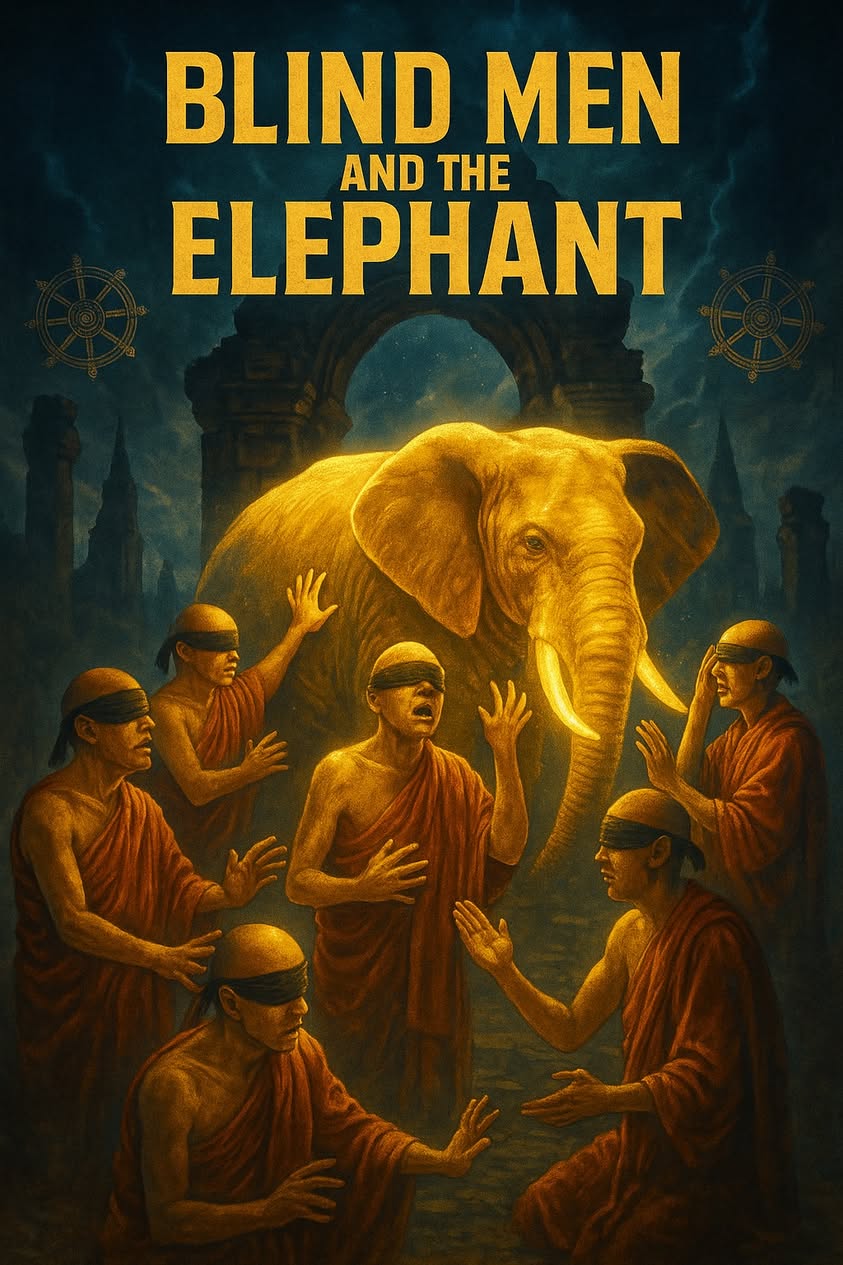
以上的法義似乎太過深奧,不易理解,對眾生而言,要理解這一番法義,好比「盲人摸象」。 This Dharma teaching may seem overly profound and difficult to comprehend. For sentient beings, to understand such meaning is like “blind people feeling an elephant.”
曾有一位老師,在黑夜中帶弟子去看大象,說要讓他們見到「真我」。弟子們有的用眼看、有的用手摸。 There was once a teacher who, during the night, took his disciples to see an elephant, saying he would let them behold the “true self.” Some used their eyes to see, others used their hands to touch.
用眼看見形體的人說:「我見到的真我,白白的又高大。」 The one who saw the form said, “I saw the true self—it was white and very tall.”
摸到象牙的人說:「真我像長矛。」 The one who touched the tusk said, “The true self is like a spear.”
摸耳朵的人說:「真我像簸箕。」 The one who touched the ear said, “The true self is like a fan.”
摸腳的人說:「真我像柱子。」 The one who touched the leg said, “The true self is like a pillar.”
摸尾巴的人說:「真我像繩子。」 The one who touched the tail said, “The true self is like a rope.”
於是每個人依自己所接觸的部位妄加判斷,進而彼此爭論,始終無法了解整體大象所代表的「真我」。 Each person formed biased conclusions based on their limited contact, leading to debates among themselves, yet none could grasp the entirety of the elephant—let alone the “true self” it represented.
從此得知,自心的本性雖然即是菩提、莊嚴清淨,但因眾生無明,故不了解其真相。 From this we understand: although the nature of the mind is inherently bodhi—noble and pure—sentient beings, due to ignorance, fail to recognize its true essence.
有情眾生的無明,使自己顛倒、執著種種相貌,進而產生貪愛等種種煩惱。再由煩惱加上造作業力,故流轉於輪迴,受種種身形,歷種種苦樂、果報,這些過程,正是一一在自心中顯現的因緣。 Because of ignorance, sentient beings fall into delusion and become attached to various appearances. This leads to afflictions such as craving. These afflictions, compounded by karmic actions, cause them to be reborn in saṃsāra, assuming various forms, experiencing diverse joys and sufferings, and undergoing various karmic results. All of these processes are conditions arising within the mind itself.
所以如來才說,「如實知自心」。 Thus, the Tathāgata taught: “Truly know your own mind.”
如果只是簡單說「自心是不生不滅的」且「自心是無所依的」,這樣的道理實在太深難懂。 If one merely states, “The mind is unborn and undying” and “The mind is without dependence,” such reasoning is indeed too profound and hard to grasp.
為了避免眾生落入執著自心「是什麼?」的執著,如來便以反向的角度來說明「自心是什麼」: To prevent beings from clinging to the concept of “what is the mind?”, the Tathāgata explained it in a reverse and deconstructive manner:
「祕密主!如來、應、正等覺,非青非黃、非赤非白、非紅紫、非水精色、非長非短、非圓非方、非明非暗、非男非女、非不男女。」 “Lord of Secrets! The Tathāgata, the Worthy One, the Perfectly Enlightened One— is neither blue nor yellow, neither red nor white, neither crimson nor crystal-colored, neither long nor short, neither round nor square, neither bright nor dark, neither male nor female, nor neither-male-nor-female.”
以上是如來以「離相的方便法」,教導眾生去細觀心的本質: 無法得見、無有生起、無有形相、也不在內外、不在中間。 This is the Tathāgata’s skillful method of “transcending appearances,” teaching beings to closely observe the nature of the mind— which cannot be seen, has no arising, no form, and exists neither inside nor outside, nor in between.
持續的觀察心的實相,終能發現「心如菩提的虛空相」,而能證悟此理的圓滿智慧,便稱為──「一切智智」。 Through continued contemplation of the mind’s true nature, one eventually realizes: “The mind is like the space-like form of bodhi.” The perfect wisdom that realizes this is known as—“the wisdom of omniscience” (sarvajñājñā).
「自心」超越一切因緣,但也並非毫無因緣就能成就的。 The “mind itself” transcends all conditions, but it is not without conditions that realization can be achieved.
到那時,才能領悟自心本不生不滅,遠離爭論,自然清淨。 Only then can one truly realize that the mind is inherently unborn and undying, free from all contention, and naturally pure.
而將此理用於「如來」一法的理解時,如來自然是如同上面所述,非青黃赤白等顏色,也無長短方圓等形狀;既非光明也非黑暗,既非男女,也非非男非女──超越一切對立的概念。 When this principle is applied to the understanding of the Tathāgata, the Tathāgata, as described above, is not of any color—blue, yellow, red, or white— nor does he possess length, width, brightness, darkness, gender, or non-gender. He transcends all dualistic concepts.
修行密法的行者,若能真正「如實知自心」,就會發現:自心即是菩提、即是如來,到那時是親自經驗了,也就不會像現在一樣,為此生起無謂的爭論了。 For a practitioner of esoteric teachings, if one can truly “know one’s own mind as it is,” then one will discover: The mind itself is bodhi—it is the Tathāgata. And when this is directly realized, one will no longer give rise to futile debates as in the past.
Translated into English by ChatGPT.